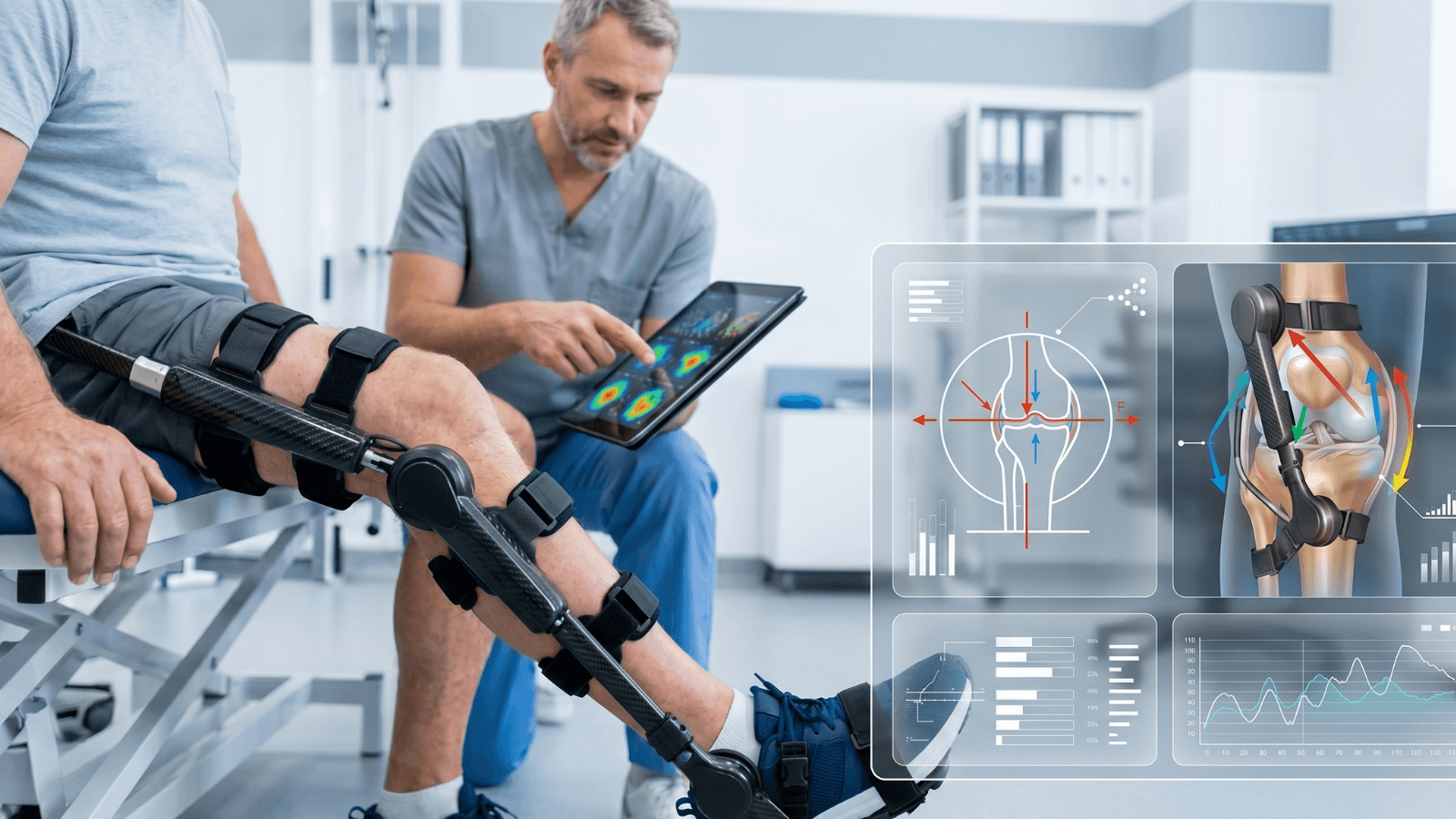
Active Knee Exoskeleton for Osteoarthritis Treatment
Group Project - Asiri Sandakelum, Saniru Abhesinhe, Chomod Rathnayaka
01 — Overview
Designed a wearable active exoskeleton to reduce Knee Adduction Moment (KAM) for mild-to-moderate knee osteoarthritis patients. The system features a bio-inspired polycentric mechanism that closely mimics natural knee kinematics.
02 — Problem Statement
Knee osteoarthritis affects millions globally, causing pain and reduced mobility. Existing passive braces provide limited relief without addressing the root biomechanical cause — elevated Knee Adduction Moment during gait.
03 — Objectives
- 01Reduce KAM during ambulation by applying corrective assistive torque
- 02Mimic the knee's Instantaneous Center of Rotation using a 5-Bar Linkage
- 03Achieve a ICR tracking error below 1 mm using Genetic Algorithm optimization
- 04Provide real-time gait phase detection and assistive torque of 25 Nm
04 — Key Outcomes
Polycentric 5-Bar Linkage optimized via Genetic Algorithm achieving 0.47 mm ICR tracking error
Remote cable-driven actuation system for reduced distal mass
FSM-based gait detection for adaptive assistive torque delivery
Impedance control strategy targeting 25 Nm assistive torque